Human-Scale Constitutional Infrastructure
Digital systems increasingly shape what people see, prioritize, and act upon — often implicitly, at scale, and without clear accountability. NICE - Networked Infrastructure for Community Enrichment - is an open ecosystem built on a constitutional foundation. NICE exists to provide a safe space to protect those we love. A space where human participation, agency, and standing are protected by design. Systems adapt to people, not the reverse.
Visual Introduction to NICE
This is a graphics-forward companion to the NICE Constitution. Below sections walk through the architecture of NICE.
Each section includes a diagram and narrative that together provide a visual and textual introduction to the system.
Where applicable, the narrative includes references to specific constitutional documents that provide
more detail on the concepts introduced in a diagram.
Orientation
NICE is structured as a stack of layers. Each layer has its own purpose, but they are designed to work together as a system. Expand below to explore the diagram and narrative.
Orientation
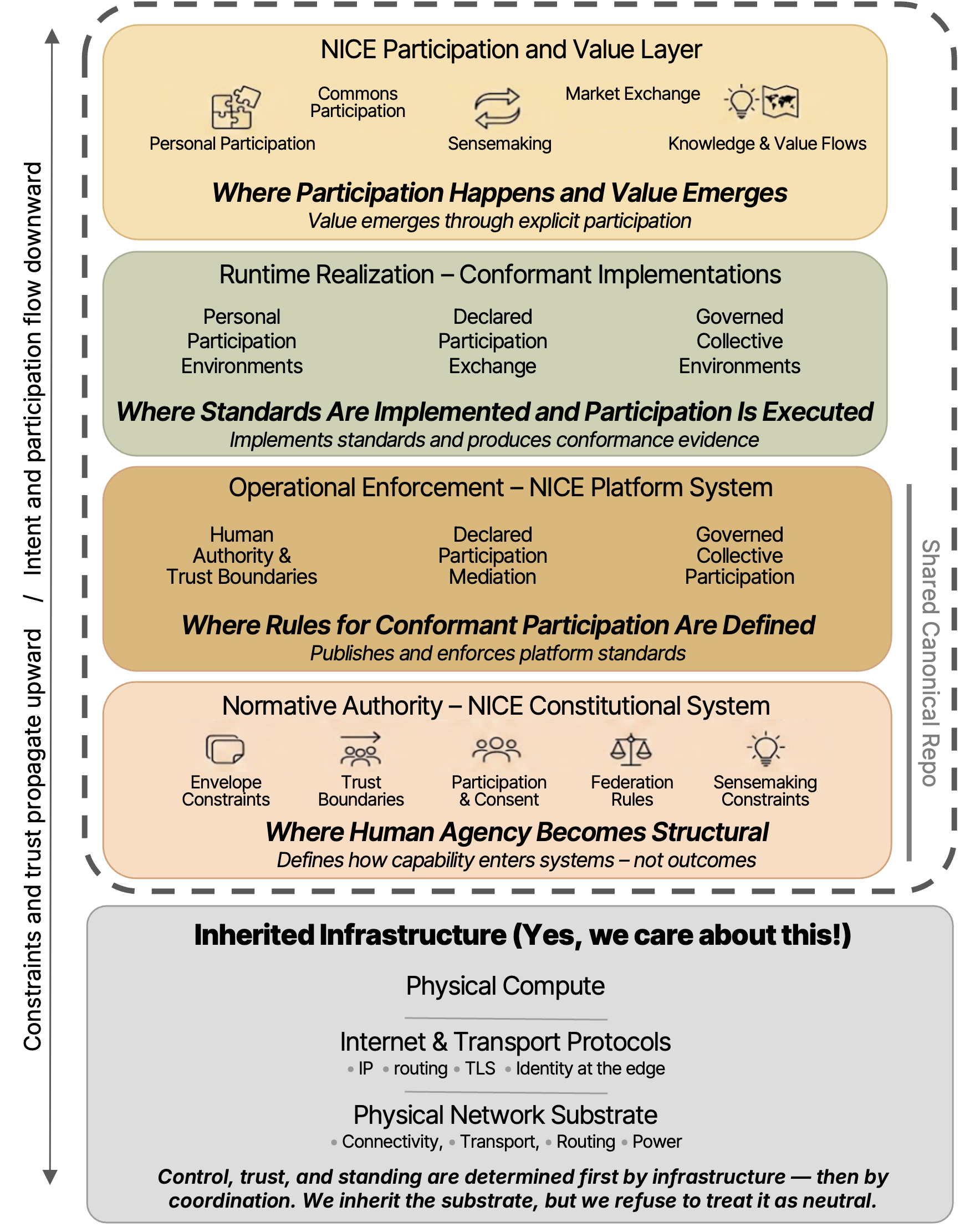
This diagram presents the full structural stack of NICE — from inherited infrastructure and constitutional authority, through platform standards and runtime realization, to participation and value.
NICE — Networked Infrastructure for Community Enrichment
Digital systems increasingly shape what people see, prioritize, and act upon — often implicitly, at scale, and without clear accountability. As data volumes grow, interpretation shifts into opaque systems optimized for engagement, efficiency, or extraction rather than human understanding.
NICE exists to reverse that dynamic by restoring explicit human participation, agency, and standing — by design.
What makes NICE different
NICE makes it possible for people and collectives to explore knowledge, collaborate, and co-create without surrendering intent, custody, or accountability. Advanced technology operates in service of human understanding — not at the expense of human judgment.
How NICE is structured
NICE is structured so that human choice comes first:
- Constitutional protections that ensure people retain control — intent, consent, custody, accountability, and the ability to exit.
- Platforms that encode those protections — replaceable, conforming implementations of shared rules that anyone may build.
- A broad capability layer where people, businesses, markets, and institutions participate as peers — under clear, shared rules.
Why businesses benefit
NICE enables forms of collaboration that are not possible without trust. Organizations that operate transparently and respect human control gain access to new kinds of cooperation, products, and markets that cannot exist in today’s systems.
A protected space within an unprotected world
NICE does not replace today’s platforms or institutions. People will continue to use familiar systems. NICE offers something different: a place where participation is protected by design. As more people choose that protection, the ecosystem grows — not by force, but by alignment.
Core invariants
- Outcomes emerge from participation — not from system authority
- Understanding improves through engagement — not hidden optimization
- Control is restored to humans — explicit and revocable
Constitutional References:
The above diagram is a visual introduction to NICE. The below constitutional documents serve as a text-based introduction to NICE.
Inherited Infrastructure
NICE does not exist in a vacuum. Human participation is constrained by physical compute, networks, power, ownership, and environment. For NICE’s constitutional protections to hold, these inherited layers must satisfy specific requirements.
Inherited Infrastructure — Constitutional Requirements
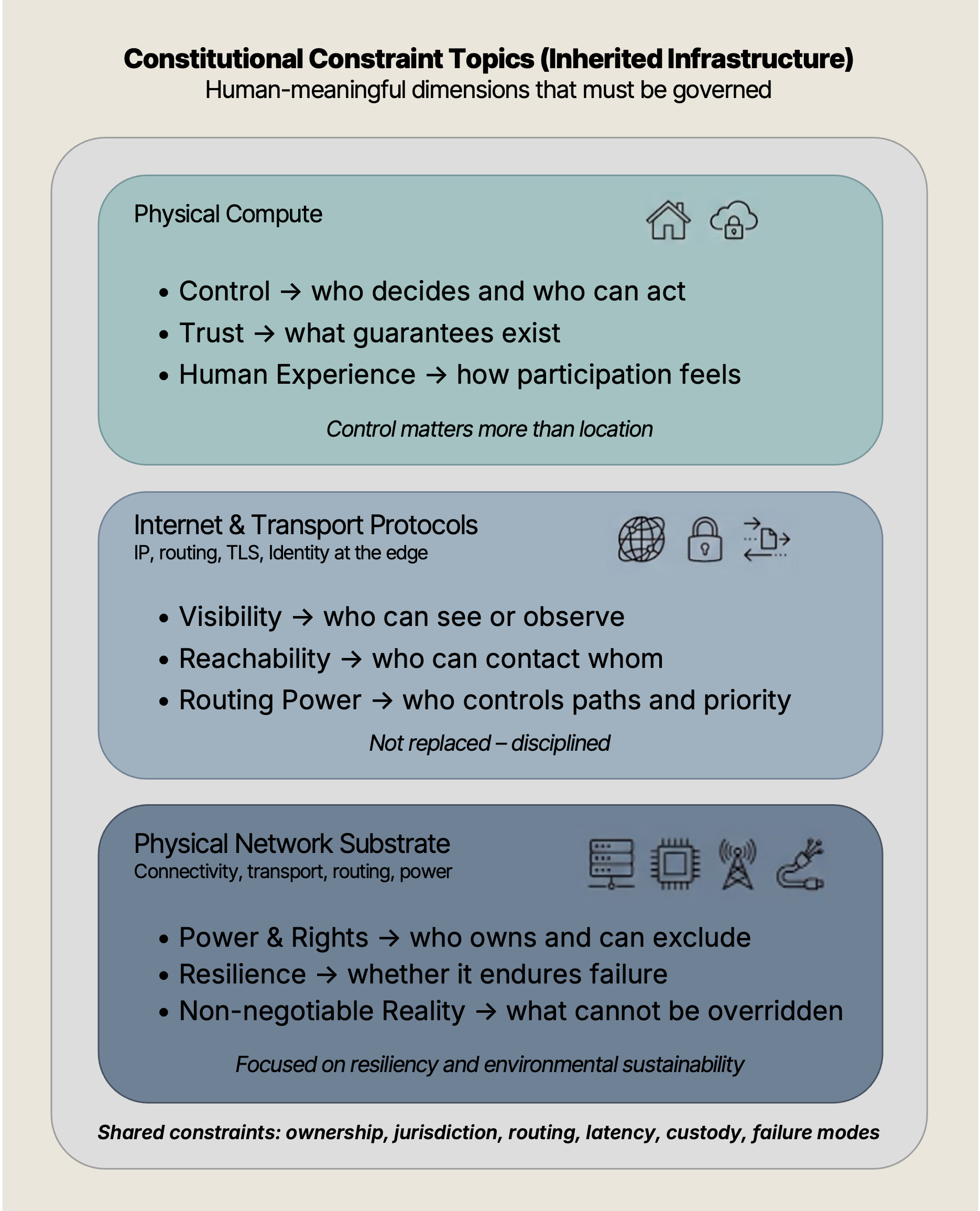
These are not optimizations or preferences — they are structural conditions.
Implications for physical compute
Because execution and custody affect human control:
- Compute must be distributed by default (homes, local nodes, bounded environments)
- Institutional compute must be accessed only through explicitly governed staging
- Ownership and operational responsibility must remain legible
Implications for internet & transport protocols
If identity and trust are not to be captured:
- Identity must be anchored at the edge, not platforms
- Peer-to-peer must be the default interaction model
- Protocols must tolerate heterogeneity, failure, and partial trust
Implications for the physical network substrate
If participation is to remain voluntary, auditable, and resilient:
- Multiple transport paths must exist (fiber, radio, satellite)
- Control points must be explicit, inspectable, and contestable
- Redundancy and failover must be architectural, not exceptional
- Power, routing, and access must function as governed surfaces, not neutral utilities
Constitutional invariants
If human participation is to remain protected, the following invariants must hold:
- No silent gatekeeping — authority must be declared
- Participants operate as peers — no privileged network positions
- Resilience is mandatory — failure is assumed
- Stewardship is required — infrastructure carries responsibility
NICE makes these implications explicit so they cannot be hidden, ignored, or quietly centralized by power or scale.
Constitutional References:
The below constitutional references pair with the above diagram.
- Physical compute: 08-inherited-infrastructure/physical-compute-declaration.md
- Internet & transport: 08-inherited-infrastructure/network-transport-declaration.md
- Physical network substrate: 08-inherited-infrastructure/physical-network-substrate-declaration.md
(These links target the constitutional source paths. Once the canon is published as web pages, they will resolve directly.)
Constitutional System
NICE provides explicit Constitutional protections that ensure people retain control — intent, consent, custody, accountability, and the ability to exit. The diagrams below are presented in reading order. Expand each panel to view the portrait graphic and its correlating narrative.
NICE Constitutional System — Constitutional Participation Map
NICE Constitutional System
Constitutional Participation Map — the fixed participation boundaries that apply before platforms, products, or implementations exist. These boundaries define conditions and limits on power — not outcomes.
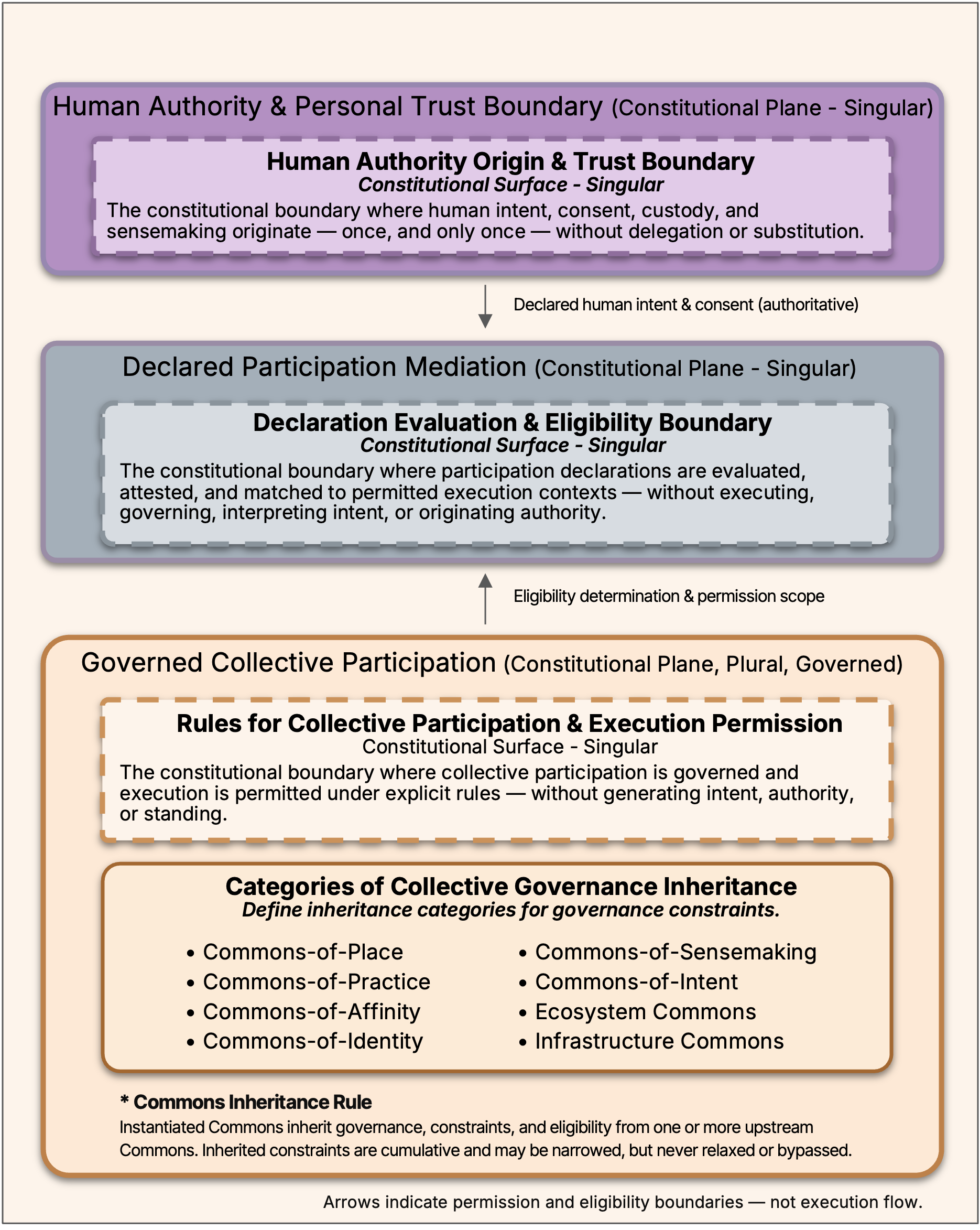
This diagram defines the fixed participation boundaries of NICE — the constitutional conditions that apply before platforms, products, or implementations exist. These boundaries define who may participate, under what conditions, and with what limits on power. They do not produce outcomes.
Human authority originates once — and only once
Human authority originates with the human and is expressed through a singular constitutional trust boundary in NICE. This boundary defines the origin of intent, consent, custody, and context for interpretation, as well as authorization. No platform, collective, or system may originate authority, reinterpret intent, or override human standing.
Participation is evaluated, not executed
Participation declarations are evaluated and matched, not executed. A singular constitutional evaluation boundary exists to evaluate declared participation, determine eligibility, and define permitted execution contexts. This boundary matches declarations to allowed contexts without executing, governing, or producing outcomes. Coordination is mediated; action remains downstream.
Collective participation is governed, not empowered
Collective participation occurs only under explicit, inherited rules. A singular constitutional governance boundary defines the rules under which collective participation is permitted and execution may occur. This boundary does not generate human intent or authority; it constrains and inherits it. Execution is permitted by rule, not driven by power. While collective participation is evaluated constitutionally, its declarations are realized through human participation via the Human Authority & Personal Trust plane acting in an appropriate role on behalf of the collective.
Collective governance is inherited by structure
Governed collectives inherit participation constraints from constitutional root categories. Inheritance is cumulative and narrowing: constraints may be added, but never relaxed. This ensures collective action can scale without capture, escalation, or authority leakage.
Execution follows permission — not power
The NICE Constitutional System defines where participation is allowed, not what outcomes must occur. Execution is always downstream, always bounded, and always permitted by constraint — never by discretion or command. Conditions are defined, not outcomes.
Constitutional References:
The above diagram is a visual rendering of the Constitutional Participation Model described in the below document.
- Participation Map: Constitutional System Participation Map
NICE Constitutional System — Personal Trust Boundary
Personal Trust Boundary
This constitutional surface defines the conditions under which a human may express intent, grant consent, hold custody, authorize bounded execution, and engage sensemaking — without delegating authority.
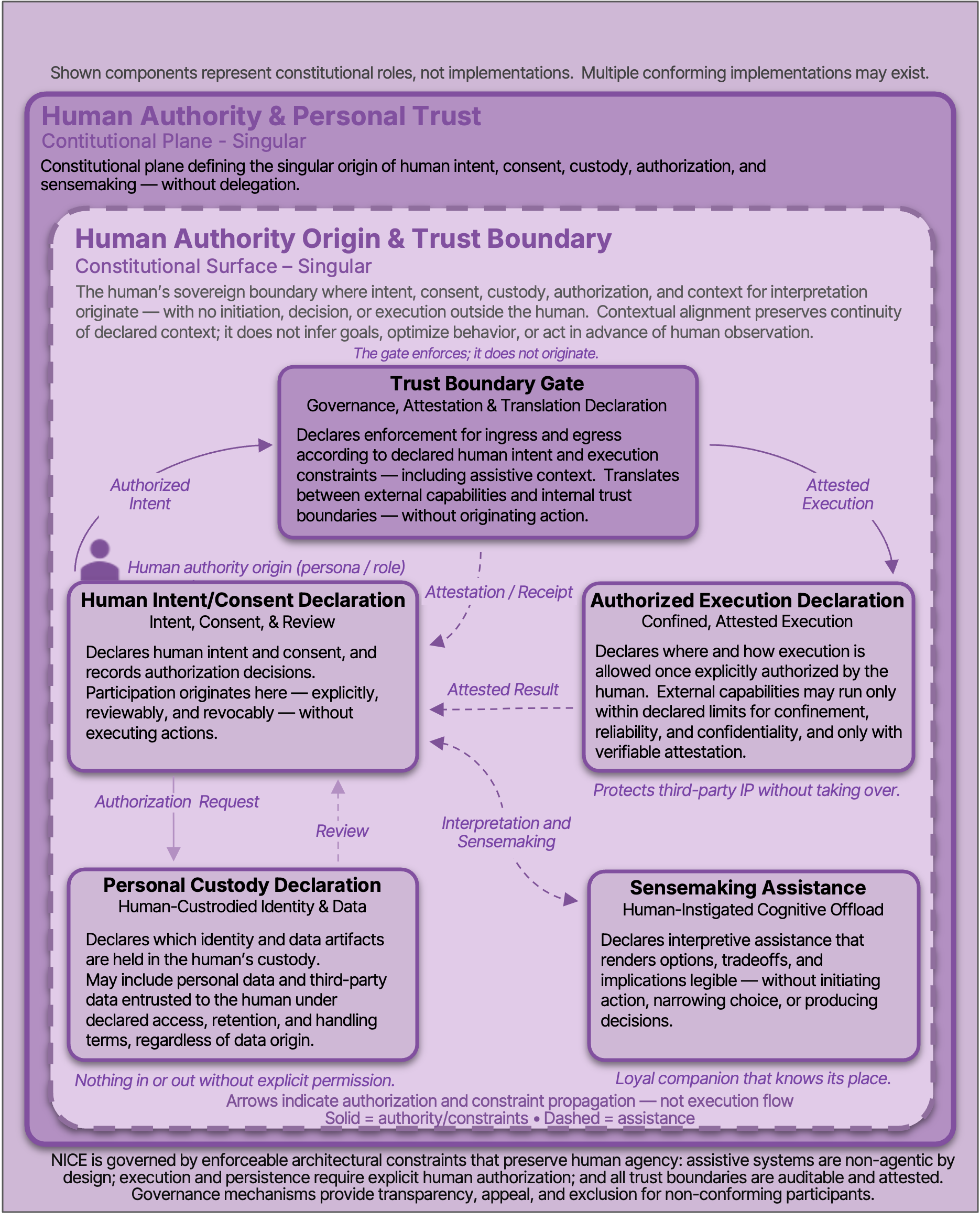
Nothing happens without the human
Nothing may enter, execute, persist, or be interpreted without explicit human authorization. This is the primary constitutional trust boundary of NICE.
Enforcement without origination
This boundary enforces declared intent, consent, and execution constraints and maintains continuity with human-declared context. It does not originate intent, interpret meaning, infer objectives, or initiate action.
Authority originates once — and only once
Human authority originates with the human and is expressed through a singular constitutional trust boundary. No platform, system, collective, or process may originate authority, reinterpret intent, or override human standing.
Assistance without delegation
Sensemaking assistance may render options, tradeoffs, and implications legible to the human, but never initiates action, narrows choice, substitutes judgment, or produces decisions. Alignment at the trust boundary preserves context; interpretation occurs only when explicitly invoked by the human.
Custody and execution are separated by design
Custody of identity and data remains with the human, including third-party data entrusted under declared terms. Execution by external execution systems is permitted only within declared, attested constraints.
Constitutional invariant
The NICE Constitutional System is not a platform and does not execute. It defines the conditions under which humans may safely and intentionally participate — and nothing more.
Sensemaking is protected constitutionally as a first-class function because human cognition is limited and must not be exploited, bypassed, or replaced.
Constitutional References:
This diagram reflects two constitutional layers: the structural plane that establishes the human as the sole source of intent, consent, custody, authorization, and interpretive context and the constitutional boundary where human-declared intent, consent, custody, authorization, and interpretive context are evaluated for permissibility — without delegation of authority or initiation of action. The Participation Model explains the plane; the Constitutional Boundary defines the limits that must be present.
- Participation Model: Plane 1 — Human Authority
- Constitutional Boundary: Declaration, Evaluation, Eligibility Boundary
NICE Constitutional System — Intermediation Boundary for Declared Participation
Intermediation Boundary for Declared Participation
NICE Constitutional System's Intermediation Boundary for Declared Participation defining how declared participation is interpreted and reconciled across NICE.
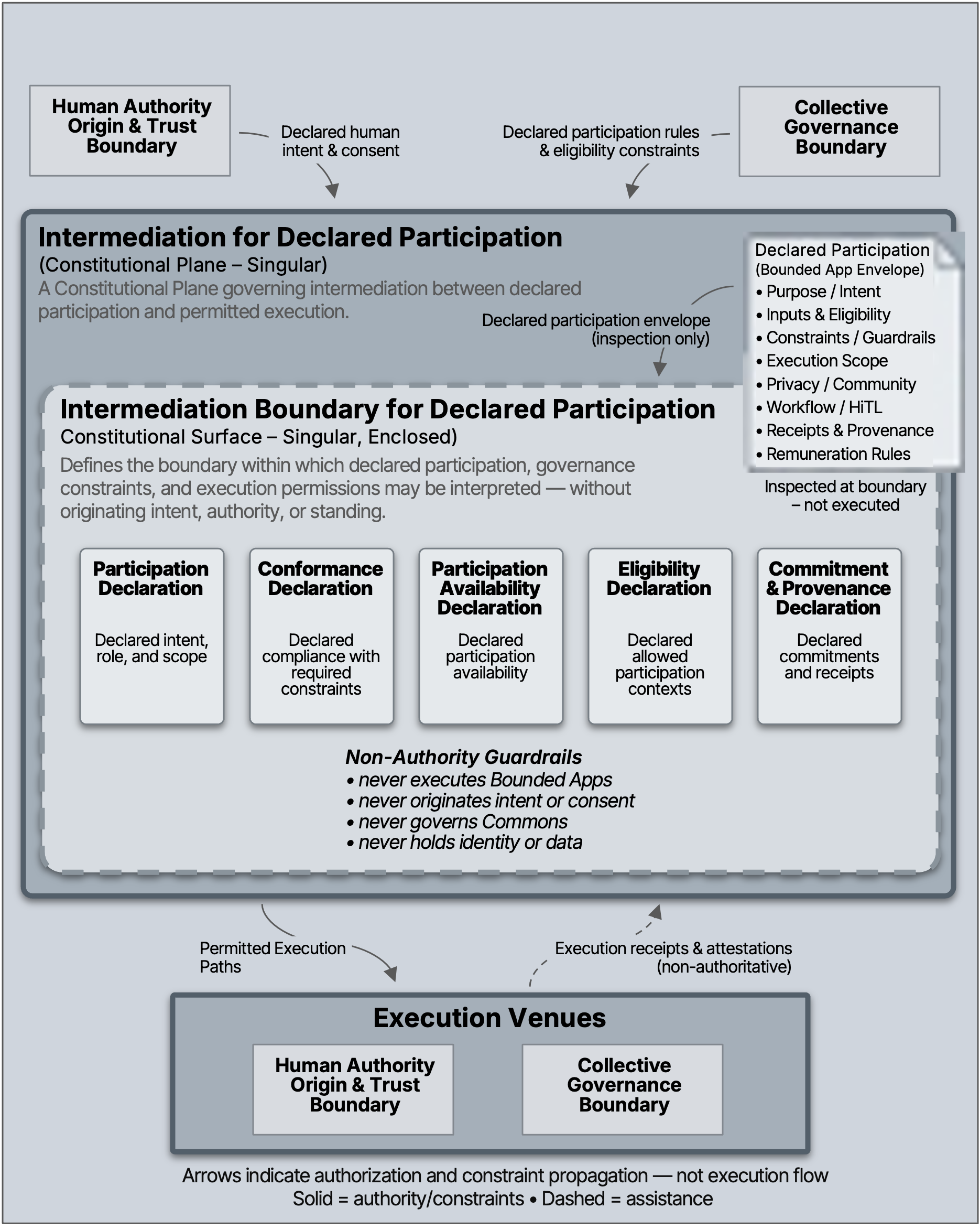
Participation is mediated — not executed
This constitutional surface defines how declared participation is interpreted and reconciled across NICE. It mediates between declared intent, declared rules, and permitted execution — without executing, governing, or deciding outcomes.
Participation occurs through declaration
All participation is expressed as explicit declarations:
- participation intent and scope
- conformance requirements
- participation availability
- eligibility contexts
- commitments and provenance
Declarations are inspected and reconciled at the boundary — never executed here.
Compatibility is evaluated. Permission is matched.
This boundary determines whether declared participation is:
- compatible with constitutional requirements
- eligible across personas, collectives, and contexts
- permitted within declared execution boundaries
It matches participation to permission. It does not grant discretion, authority, or control. The envelope may declare interpretive affordances, but never execution logic or behavioral intent
Execution is downstream and bounded
When execution occurs, it does so only in venues authorized by existing trust and governance boundaries. This surface makes permission legible; it does not select, initiate, or route execution.
Accountability without control
Execution venues return receipts and attestations through this boundary. These artifacts establish transparency and auditability without conferring custody or enforcement power.
Constitutional invariant
The Intermediation Boundary enables coordination without central platforms, hidden gatekeepers, or delegated authority. Participation is mediated. Authority remains human.
Constitutional References:
This diagram reflects two constitutional layers: the structural plane that defines how declared participation is reconciled in NICE without granting authority, initiating execution, or exercising discretion and the constitutional surface where declared participation is reconciled across multiple humans, personas, collectives, and execution contexts without transferring authority, intent, or standing. The Participation Model explains the plane; the Constitutional Boundary defines the limits that must be present.
- Participation Model: Plane 2 — Declared Participation Mediation
- Constitutional Boundary: Declared Participation Mediation Boundary
NICE Constitutional System — Governed Collective Coordination
Governed Collective Coordination - Participation Without Capture
This constitutional surface defines the conditions under which collective participation may occur. It enables coordination under explicit, inherited rules — without originating human intent, authority, or outcomes. The constitution defines where and under what constraints collective action is allowed. It does not decide what must be done.
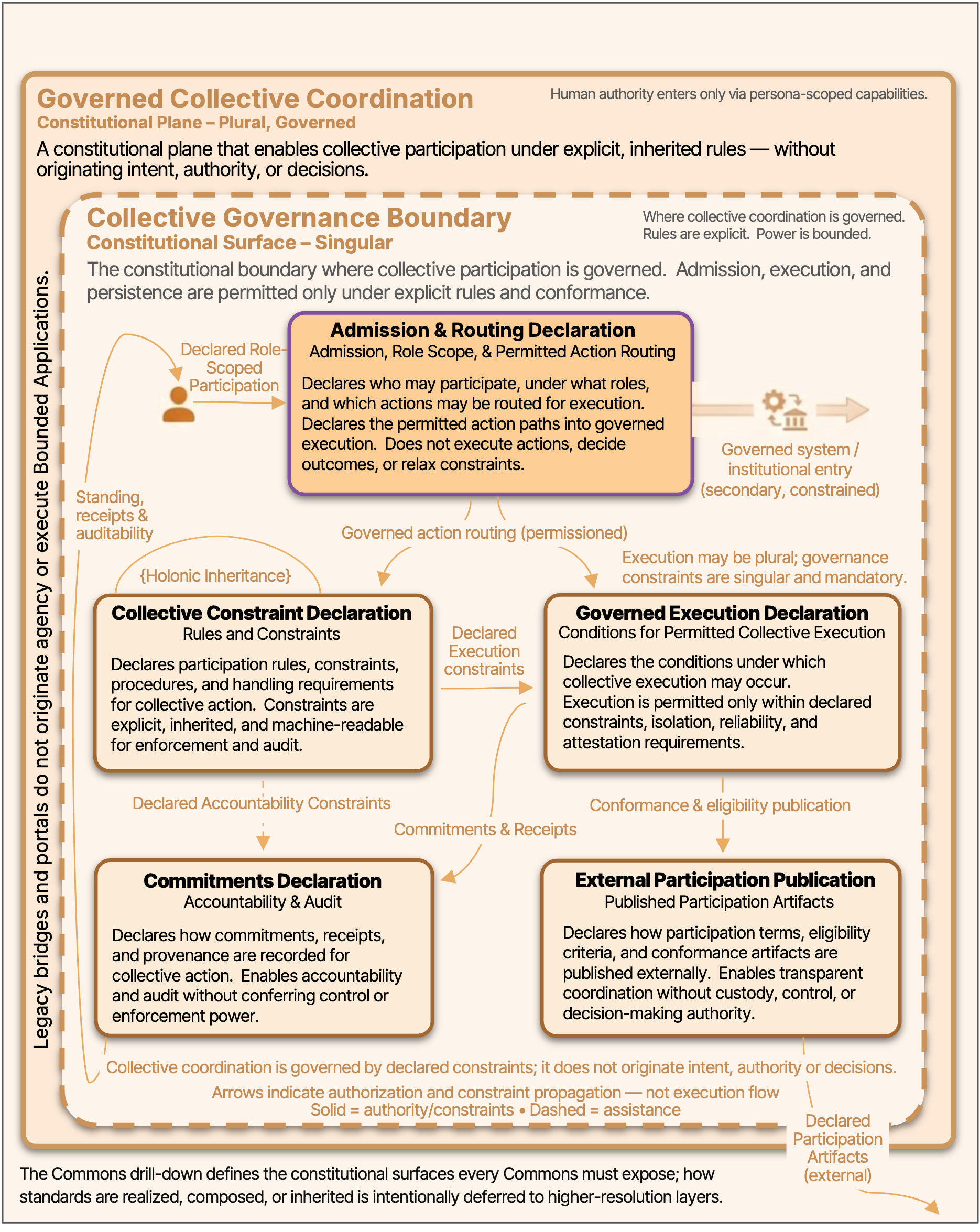
Human authority enters only through constrained participation
All collective participation is mediated by persona-scoped declarations issued upstream through the personal trust boundary. Human authority is never transferred to the collective. It is constrained, scoped, and exercised only through declared roles and permissions.
Admission and routing are declared — not discretionary
An admission and routing declaration specifies: Who may participate; Under which roles; Which actions may be taken; Which execution paths are permitted. No declaration grants authority to execute, decide outcomes, or relax constraints. It only permits participation under rule.
Collective constraints are explicit and inherited
Collective constraint declarations define the rules, limits, procedures, and handling requirements that govern participation. Constraints are: Explicit; Inherited from upstream governance; Cumulative and narrowing. They may be added — never removed.
Execution conditions are permitted, not commanded
A governed execution declaration specifies the conditions under which collective execution may occur. It defines: Permitted execution contexts; Required isolation, reliability, and attestation conditions. Execution is always bounded by declaration and may be plural across permitted contexts.. No single surface controls outcomes.
Accountability is recorded, not enforced
Commitment and accountability declarations ensure that: Commitments, receipts, and provenance are recorded; Participation is auditable after the fact. Accountability is established without control, custody, or enforcement power.
Participation terms are published, not hidden
External participation publication declares: Eligibility criteria; Participation terms; Conformance artifacts. These are published externally to enable transparent participation — without granting authority, custody, or decision-making power.
Constitutional invariant
This constitutional surface coordinates collective participation. It does not generate intent, authority, or outcomes. NICE defines where collective participation is allowed — and under what conditions. That’s it.
Constitutional References:
This diagram reflects two constitutional layers: the structural plane that enables governed collective participation, and the singular boundary that defines its constraints. The Participation Model explains the plane; the Constitutional Boundary defines the limits that must be present.
- Participation Model: Plane 3 — Governed Collective Participation
- Constitutional Boundary: Commons Governance Boundary
Platform System
Constitutional protections must be encoded in platforms. This section is where rules for conformant participation are defined. The diagrams below are presented in reading order. Expand each panel to view the portrait graphic and its correlating narrative.
NICE Platform System — Platform Participation Map
NICE Platform System
Platform Participation Map — the fixed participation boundaries that apply before platforms, products, or implementations exist. These boundaries define conditions and limits on power — not outcomes.
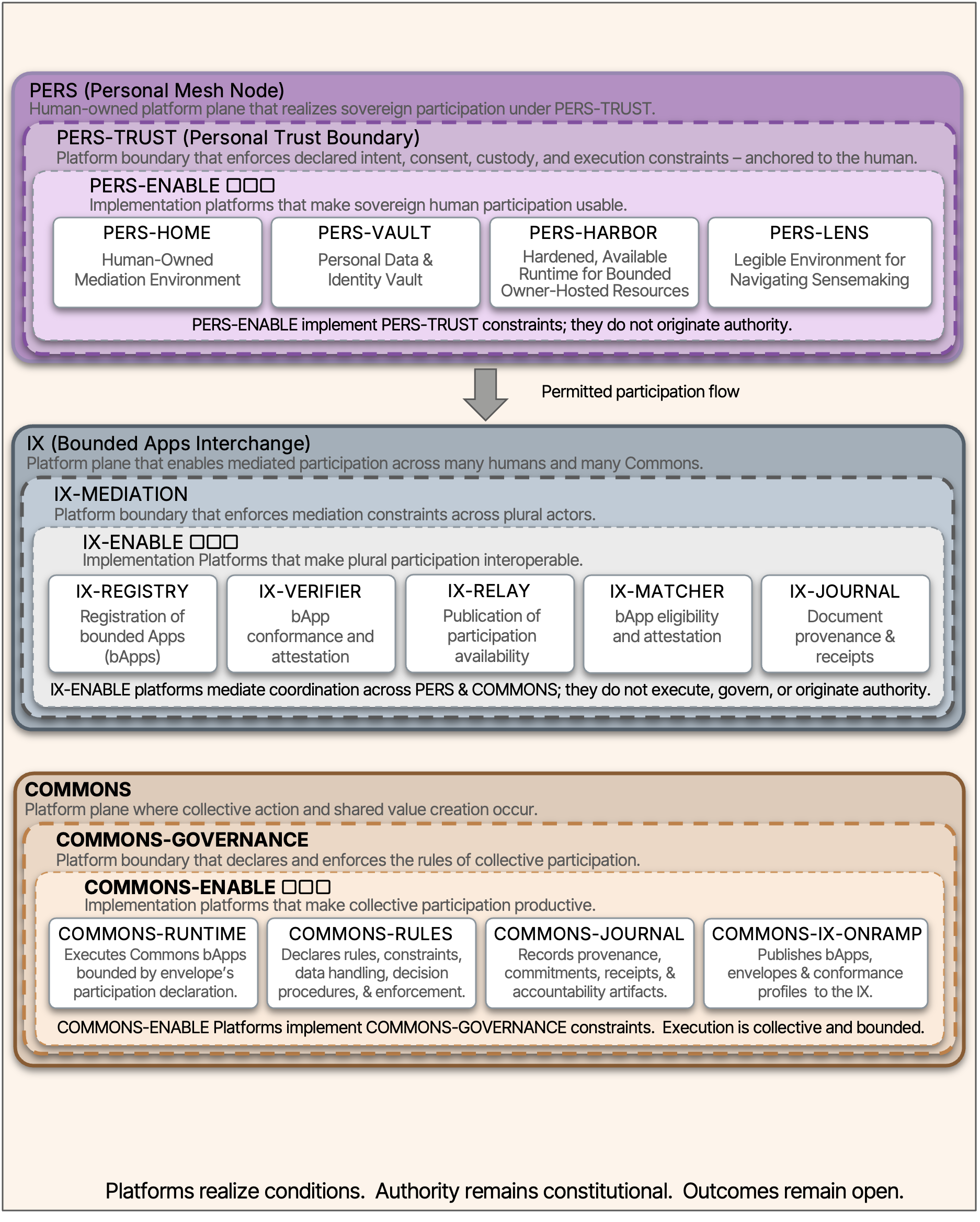
NICE separates authority from execution. Platforms exist to make constitutional participation usable at human scale — without absorbing authority, discretion, or intent. Humans retain constitutional standing at all times. Platforms do not hold authority — they realize conditions under which participation is possible.
PERS — Makes sovereign human participation usable and safe
PERS is the human trust boundary. It anchors identity, intent, consent, custody, authorization, and continuity of declared context to a specific human under PERS-TRUST. All participation originates here — explicitly, revocably, and auditable. PERS enables action without delegating authority. Authority, intent, and standing remain human.
PERS-TRUST maintains continuity and alignment with human-declared context and constraints. Interpretation and meaning-making occur only through explicit human-invoked assistance and never at the boundary itself.
IX — Makes plural participation interoperable
IX is the constitutional mediation plane. It reconciles declarations, eligibility, conformance, and execution paths across many PERS and many Commons — without executing, governing, or taking custody.
IX publishes eligibility and permission scope; recipients evaluate participation options and route execution under their own authority. IX does not interpret meaning or provide sensemaking; it reconciles declared participation only. It matches participation; it does not decide outcomes or grant discretion.
COMMONS — Makes collective participation productive
Commons are where collective execution and shared value creation occur. Activities are collective, rule-bound, auditable, and accountable — but always constrained by governance inherited from upstream.
Commons act at scale without overriding individual agency. Execution is plural; governance is singular and mandatory.
The core invariants
- Platforms realize conditions
- Authority remains human and constitutional
- Outcomes remain open
Constitutional References:
Standards Indexes are established in the Constiutution Repository -- by Standards Family. Relevant constitutional documents are shared below. Note that identifiers communicated in these index documents correlate to drill-down graphics that follow for each Platform Plane.
- Constitutional Standards Index: Constitutional Standards Index
- Interface Standards Index: Interface Standards Index
- Role Standards Index: Role Standards Index
NICE Platform System: PERS - Human-Authorized Personal Execution & Assistance
PERS - Human-Authorized Personal Execution & Assistance
This Platform Plane (NICE-RS-PERS) defines how human-sovereign participation is made operational in NICE — without transferring authority, standing, or decision-making away from the human.
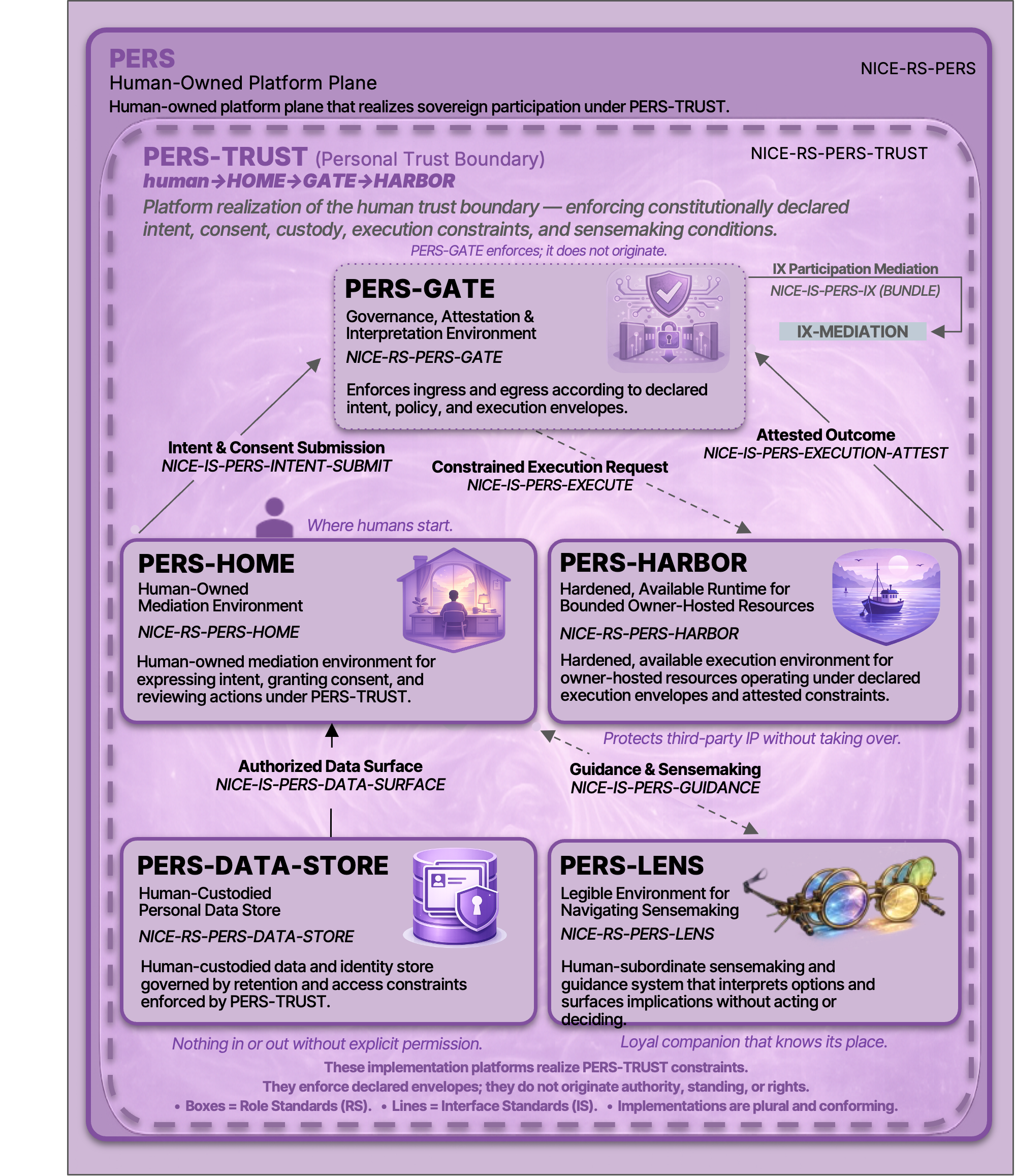
The PERS Platform Plane (NICE-RS-PERS) defines how human-sovereign participation is made operational in NICE — without transferring authority, standing, or decision-making away from the human. Platforms at this layer do not decide what is allowed. They realize and enforce conditions declared upstream by the constitutional system, not outcomes.
PERS-TRUST — Enforcement boundary & sensemaking substrate
PERS-TRUST (NICE-RS-PERS-TRUST) is the enforcement boundary of the plane and the substrate that remains in lock-step with the human. It enforces declared intent, consent, custody, and execution constraints, and provides attestation of outcomes.
This substrate is analogous to an operating system: it maintains continuous coherence with the human, so declared intent is ready to be acted upon when — and only when — the human initiates action. It does not infer goals, interpret meaning, optimize behavior, or make decisions.
Platform roles (implementation platforms)
Within this boundary, a set of implementation platforms realize these constraints in practice:
- PERS-GATE — governance, translation, and attestation
- PERS-HOME — human-owned mediation and authorization
- PERS-HARBOR — hardened, attestable execution environment
- PERS-VAULT — human-custodied identity and personal data
- PERS-LENS — non-authoritative sensemaking and interpretive assistance
Each platform has a defined role, is governed by a Role Standard, and may have multiple conforming implementations. None originate authority or standing.
Assistance without delegation
Sensemaking assistance may render options, tradeoffs, and implications legible to the human, but never initiates action, narrows choice, substitutes judgment, or produces decisions. Alignment at the trust boundary preserves context; interpretation occurs only when explicitly invoked by the human.
Interfaces, not authority
All interaction between PERS platforms occurs through explicit Interface Standards (NICE-IS-*). Interfaces route, constrain, and attest participation flows — they never decide, govern, or take custody.
Core invariant
Platforms realize conditions. Authority remains constitutional and human.
All platform planes conform to the shared standard families defined in the Platform Participation Map.
NICE Platform System: IX - Bounded Apps Interchange
NICE Platform System: IX - Bounded Apps Interchange
The IX Platform Plane (NICE-RS-IX) defines how plural participation is made interoperable in NICE — without transferring authority, intent, or standing from humans or Commons. Platforms at this layer do not decide what is allowed. They mediate, reconcile, and route constitutionally-constrained participation declarations.
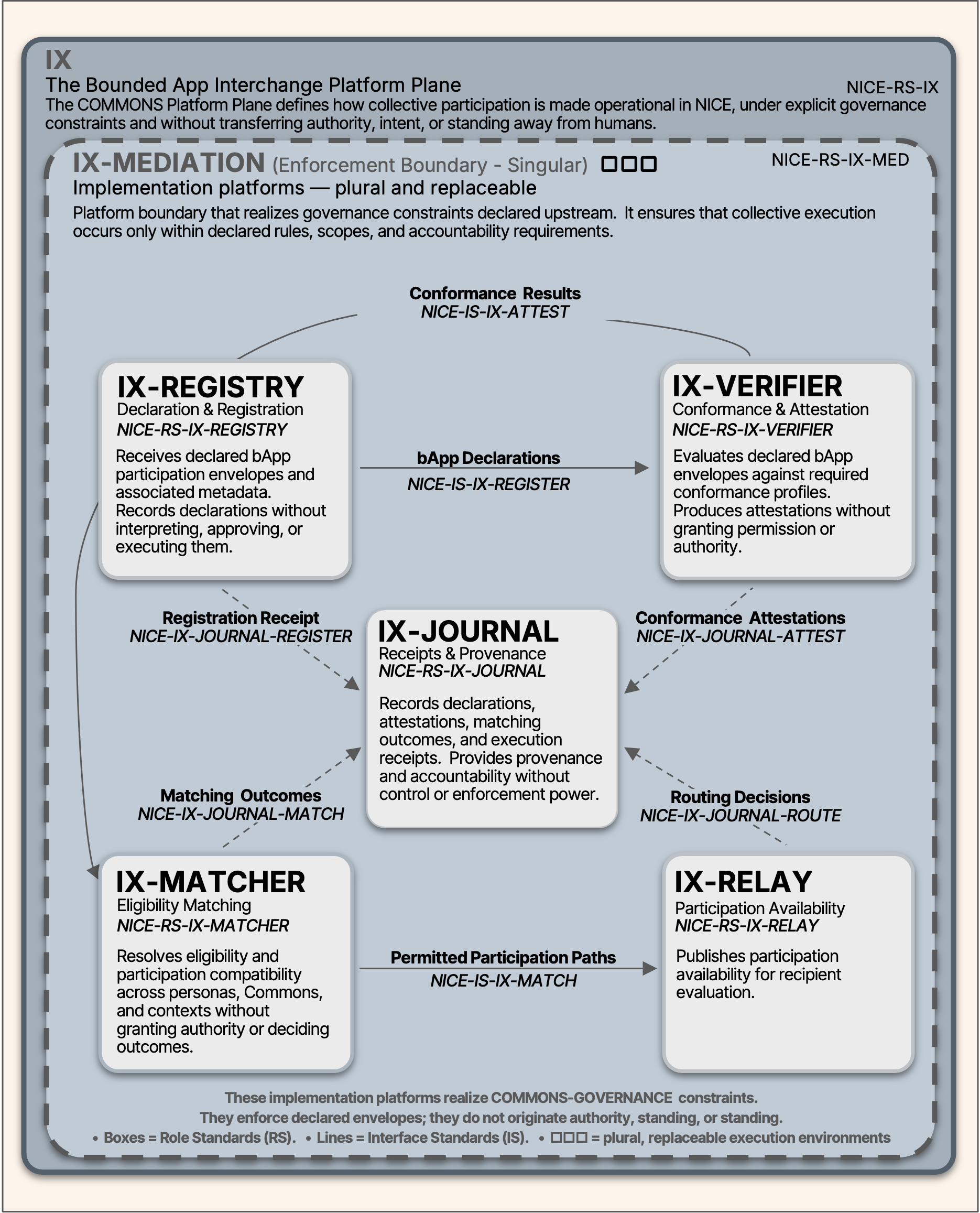
The IX Platform Plane (NICE-RS-IX) defines how plural participation is made interoperable in NICE — without transferring authority, intent, or standing from humans or Commons. Platforms at this layer do not decide what is allowed. They mediate, reconcile, and route constitutionally-constrained participation declarations.
IX-MEDIATION — The mediation boundary
IX-MEDIATION (NICE-RS-IX-MED) is the singular mediation boundary of the plane. It ensures that participation across many PERS and many COMMONS is compatible, bounded, and auditable — without executing, governing, or directing outcomes.
IX-MEDIATION enforces declared constraints; it does not originate authority, grant permission, interpret meaning or execute actions.
Platform roles (implementation platforms)
Within this boundary, a set of implementation platforms realize mediation in practice:
- IX-REGISTRY — declaration and registration of bApp participation envelopes
- IX-VERIFIER — conformance and attestation against declared requirements
- IX-MATCHER — eligibility and participation context matching
- IX-ROUTER — publication of participation availability (mediated)
- IX-JOURNAL — receipts, attestations, and provenance records
Each platform has a defined role, is governed by a Role Standard, and may have multiple conforming implementations. None originate authority, intent, or outcomes.
Interfaces, not authority
All interaction between IX platforms occurs through explicit Interface Standards (NICE-IS-*). Interfaces declare, attest, reconcile, publish, and record participation flows — they never decide, govern, notify, or take custody. Publication expresses availability; participation is evaluated and routed by recipients under their own authority — never by IX.
Core invariant
The Intermediation Boundary enables coordination without central platforms, hidden gatekeepers, or delegated authority. Participation is mediated. Authority remains human.
- Platforms realize conditions. Authority remains human and constitutional.
- Execution remains downstream.
- Outcomes remain open.
Constitutional References:
These declaration definitions are the artifacts exchanged through IX; IX standards define format, validation, eligibility, conformance evidence, and publication rules.
IX Drill-down — bApp Participation Declarations
IX Drill-down — bApp Participation Declarations (bApp Envelope)
Participation declarations are the interoperable artifacts exchanged through IX. They do not execute actions. They describe availability, visibility, and participation terms so eligibility can be evaluated and routing can be permissioned.
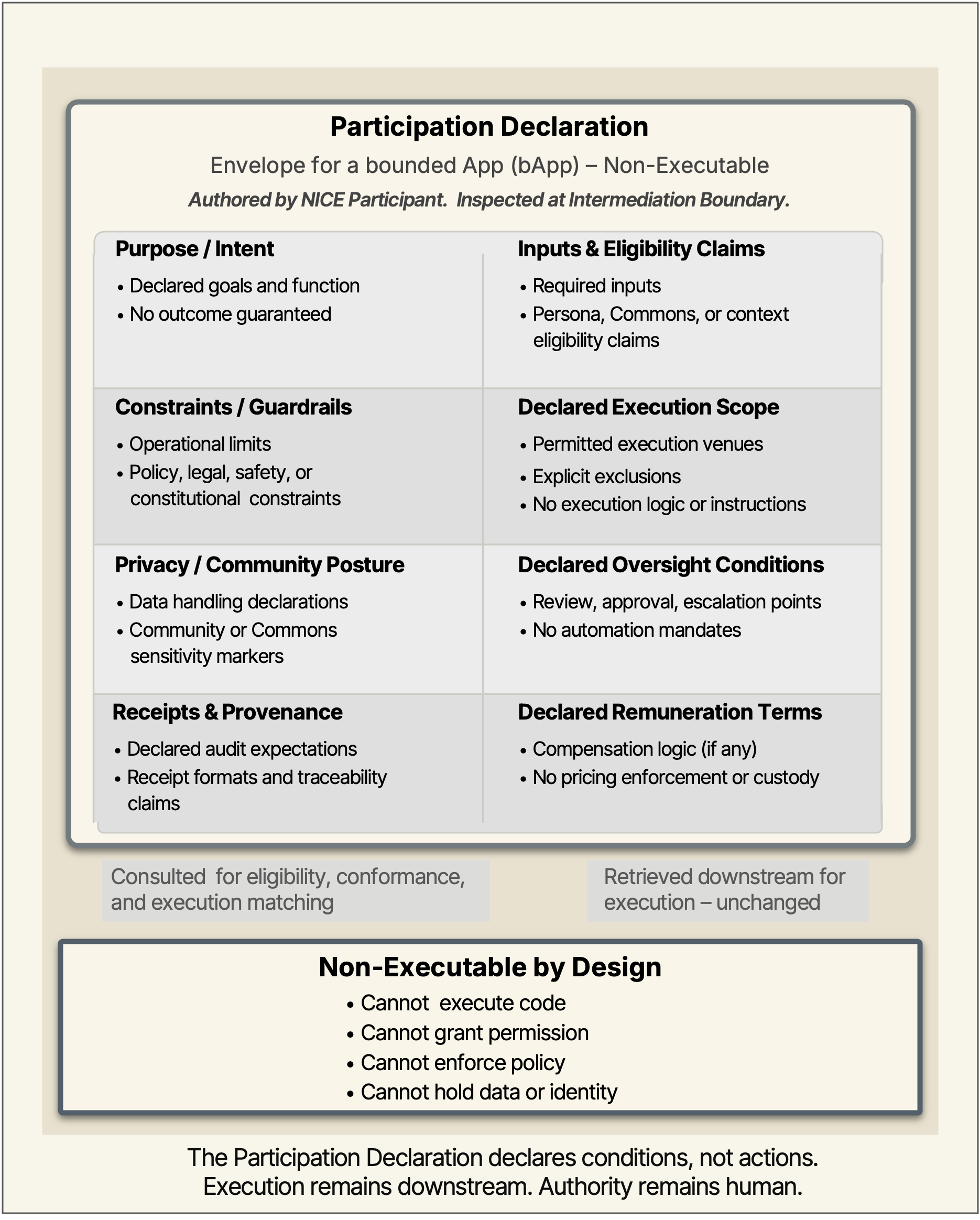
Declarative, not executable
The Participation Declaration defines how a bounded App (bApp) may participate in NICE. It is a structured declaration of intent, scope, and constraints — not a description of behavior or execution.
Authored by participants. Available for inspection at the boundary
Participation Declarations are authored by NICE participants and made available to the Intermediation Boundary when participation is evaluated.
Conditions are declared — actions are not
The declaration specifies:
- what a bApp is intended to do
- what inputs and contexts it may rely on
- where execution may occur
- and which constraints must always hold
It does not define how execution happens, guarantee outcomes, or authorize action.
Used for matching – not permission
Participation Declarations are consulted to evaluate compatibility across:
- what a bApp is intended to do
- what inputs and contexts it may rely on
- where execution may occur
They enable matching — not control, discretion, or enforcement.
Execution remains downstream and bounded
When participation is permitted, execution venues reference the declaration unchanged, operating under human authority and existing governance boundaries.
Core invariants
- Participation is declared, not commanded.
- Declarations are pulled for inspection, not pushed for execution.
- Conditions are inspected, not enforced.
- Execution remains downstream. Authority remains human.
Declaration references
NICE Platform System — Collective Execution Platform Plane
NICE Platform System — Collective Execution Platform Plane
The COMMONS Platform Plane (NICE-RS-COMN) defines how collective participation is made operational in NICE — without transferring authority, intent, or standing away from humans.
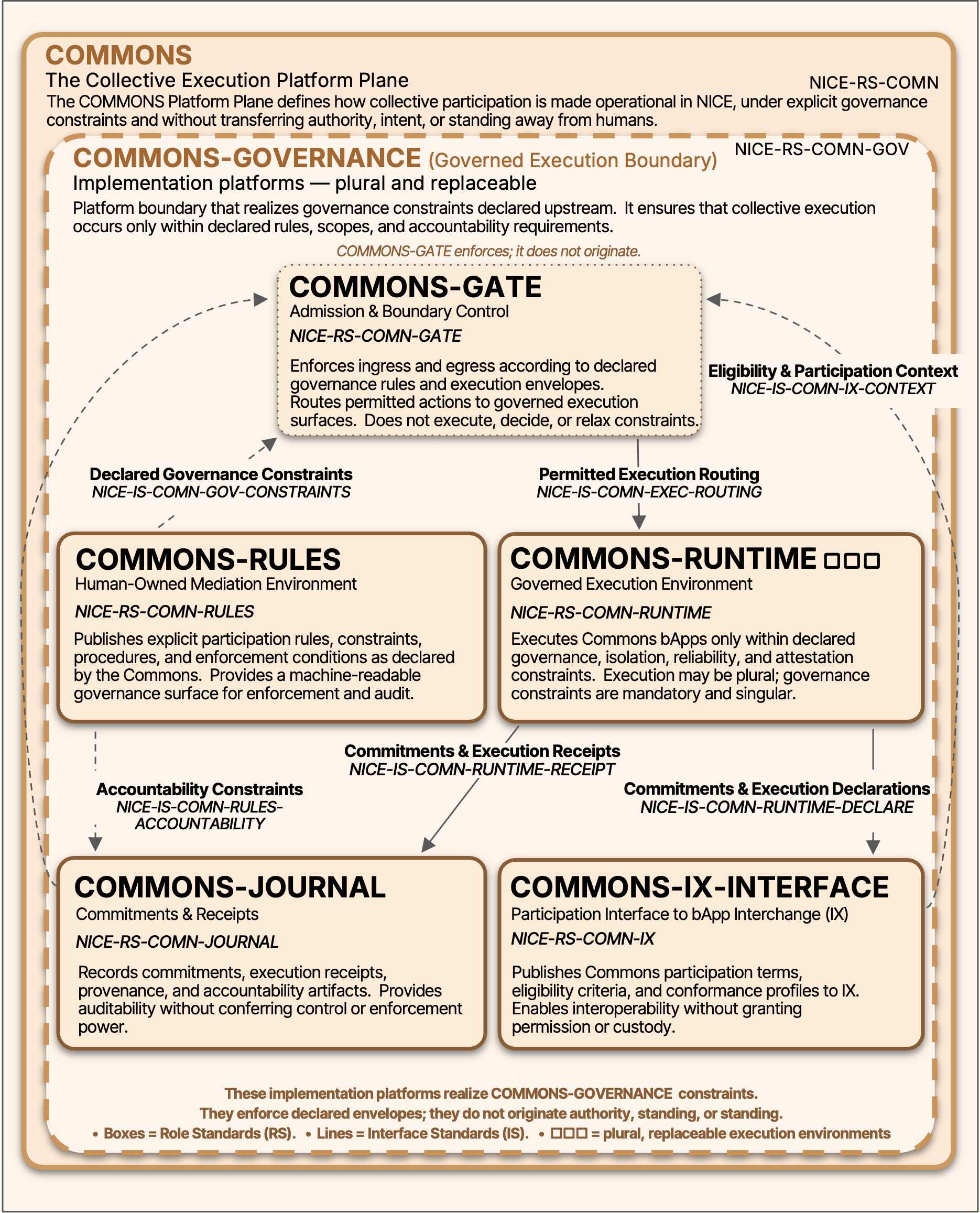
The COMMONS Platform Plane (NICE-RS-COMN) defines how collective participation is made operational in NICE — without transferring authority, intent, or standing away from humans.
Platforms at this layer do not decide outcomes or permissions. They realize and enforce conditions declared upstream by the constitutional system.
COMMONS-GOVERNANCE — The enforcement boundary
COMMONS-GOVERNANCE (NICE-RS-COMN-GOV) is the enforcement boundary of the plane. It ensures that nothing enters, executes, or persists without declared governance, participation constraints, and accountability requirements. COMMONS-GOVERNANCE enforces constraints; it does not originate authority, intent, or outcomes of its own.
Collective constraints are explicit and inherited
Collective constraint declarations define the rules, limits, procedures, and handling requirements that govern participation. Constraints are: Explicit; Inherited from upstream governance; Cumulative and narrowing. They may be added — never removed.
Platform roles (implementation platforms)
Within this boundary, a set of implementation platforms realize these constraints in practice:
- COMMONS-GATE — admission, boundary control, and permitted execution routing
- COMMONS-RULES — declaration of participation rules and constraints
- COMMONS-RUNTIME — governed collective execution environments
- COMMONS-JOURNAL — commitments, receipts, and accountability artifacts
- COMMONS-IX-INTERFACE — publication of participation terms to IX
Each platform has a defined role, is governed by a Role Standard, and may have multiple conforming implementations. None originate authority or intent.
Interfaces, not authority
All interaction between Commons platforms occurs through explicit Interface Standards (NICE-IS-*). Interfaces route, constrain, and attest participation flows — they never decide, govern, or take custody.
Core invariant
- Platforms realize conditions. Authority remains human and constitutional.
- Execution may be plural; governance is singular.
- Outcomes remain open.
Runtime Realization — Conformant Implementations
This layer is where NICE platform standards are implemented as running systems and participation is executed in practice. NICE defines the requirements for conformance and evidence, but conformant implementations will be developed and operated by partners. As partnerships are formed through NICE Stewardship Council, LLC (via nicesteward.org), this section will expand with concrete runtimes and attestations.
What “Runtime Realization” means in NICE
Runtime realization is the bridge between standards and lived participation. It is not a new source of authority. It is where conformant implementations execute permitted participation under constitutional constraints and platform standards, and where conformance evidence can be produced, audited, and revoked when necessary.
- Implements standards — replaceable implementations that encode shared rules.
- Executes participation — permitted actions occur in bounded environments, not in constitutional surfaces.
- Produces evidence — conformance, receipts, and audit artifacts that make participation inspectable.
Personal Participation Environments (PERS runtimes)
Personal Participation Environments are conformant runtimes that enable humans to participate without surrendering intent, custody, or standing. These runtimes will vary by implementation, but must remain compliant with NICE constitutional constraints and platform standards.
Coming soon: reference implementations, partner runtimes, and conformance/attestation pathways.
Declared Participation Exchange (IX runtimes)
Declared Participation Exchange is realized through conformant IX runtimes that can evaluate, match, route, and journal declared participation without collapsing into discretionary control. Declarations remain the unit of exchange; execution remains downstream.
Coming soon: commercial and open implementations, interoperability test suites, and published conformance evidence.
Governed Collective Environments (Commons runtimes)
Governed Collective Environments are conformant runtimes where collective participation can execute under explicit, inherited rules — without originating human intent, authority, or outcomes. Governance rails are singular; execution may be plural.
Coming soon: Commons operating patterns, governance surfaces, and partner-operated runtime profiles.
NICE Participation & Value Layer
This layer shows how humans and Commons coordinate under constitutional protections and platform conformance — where participation happens and value emerges.
Minimum Global Commitments — Root Commons Inheritance
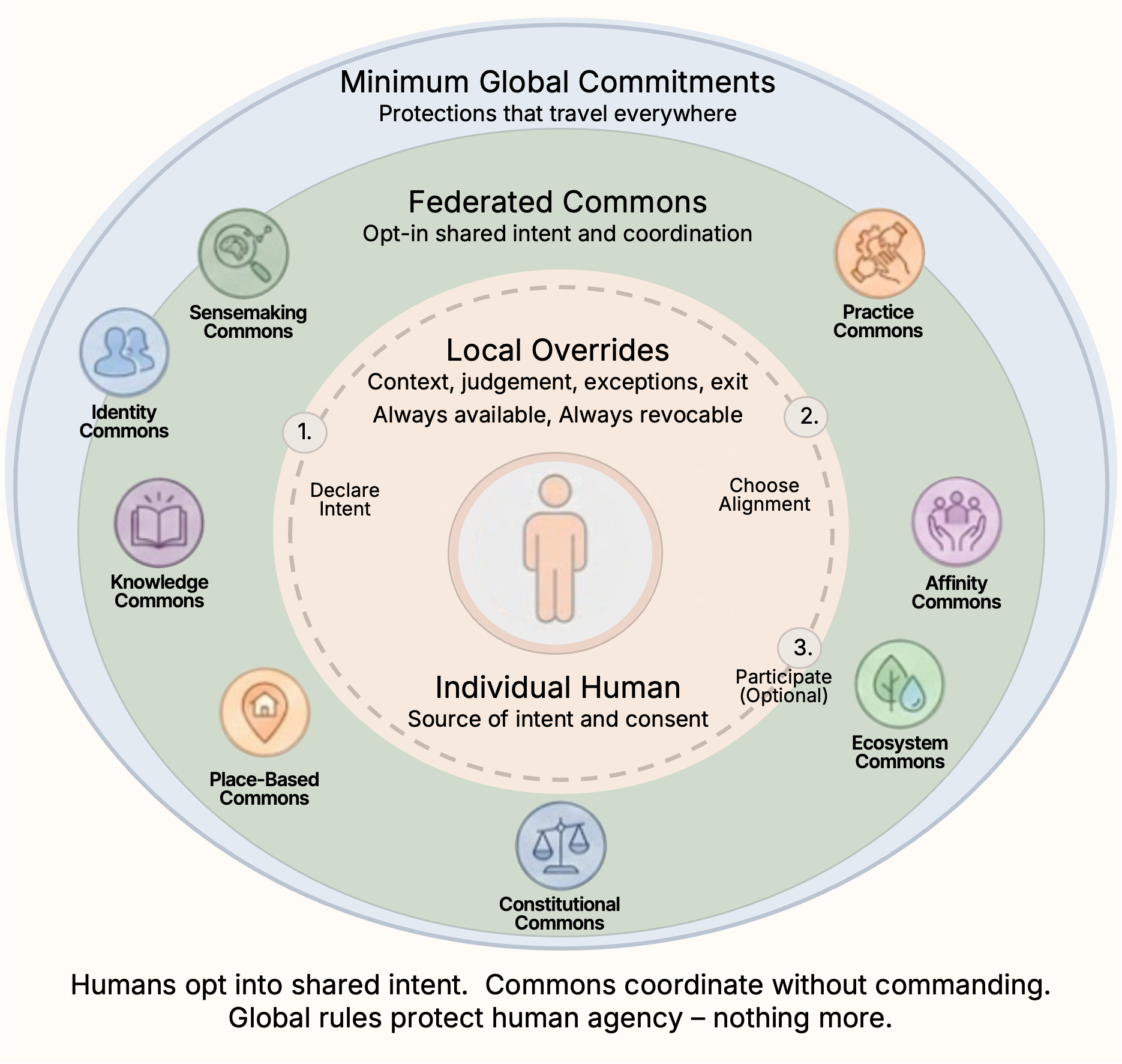
NICE preserves a small set of minimum global commitments that travel everywhere: human agency preserved, explicit consent required, and exit always available. These commitments are inherited by all Commons as constitutional constraints and guarantees — not operated as discretionary authority.
Opt-in coordination without command
Commons enable shared intent and coordination, but do not command outcomes. Local context, judgment, exceptions, and exits remain available and revocable. Global rules protect human agency — nothing more.
Commons Creation & Stewardship
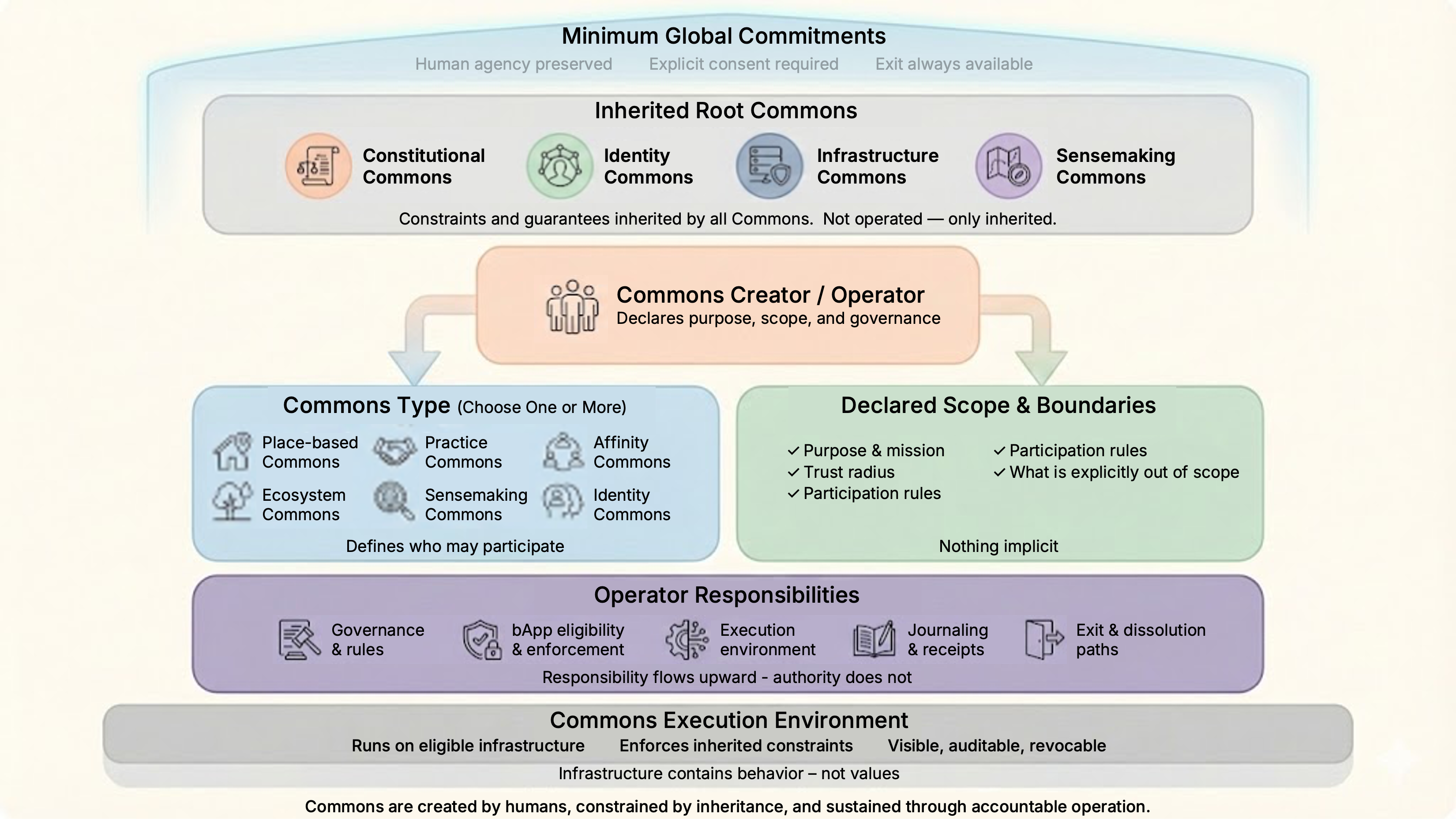
Commons are created by humans under explicit, inherited constraints. The creator/operator declares purpose, scope, participation rules, and what is explicitly out of scope. Nothing is implicit. Responsibilities flow upward; authority does not.
Governance is explicit and auditable
Operator responsibilities include governance and rules, eligibility and enforcement, execution environment, journaling and receipts, and exit and dissolution paths. Commons execution remains visible, auditable, and revocable.
Canonical Constitution Repository
The authoritative constitutional text lives in the NICE Constitution repository.
Recommended entry points
- Reading guide: 00-introduction/reading-guide.md
- Participation model: 01-participation-model/
- Constitutional boundaries: 02-constitutional-boundaries/
- IX declarations (bApp interchange): 03-declarations/
- Standards indexes (required families): 04-standards/
- Inherited infrastructure constraints: 08-inherited-infrastructure/
- Visuals: 07-visuals/
Help Us Get This Right
We're seeking partners who can help pressure-test, refine, and strengthen the constitutional framework.